

Key Takeaways:
- One Norway rat was able to create serious food safety and regulatory concerns inside a neighborhood grocery store before it was captured.
- Ceiling insulation provided the perfect nesting location, while poorly protected exterior doors and open loading docks made it easy for rodents to enter the building.
- Standard trapping methods were ineffective because the rat consistently avoided unfamiliar objects.
- A carefully concealed trap paired with alternative bait ultimately resulted in a successful capture.
- Long-term results depended on structural improvements, employee education, and coordinated rodent management.
A Small Rodent Created a Big Problem
For grocery stores, even a single rodent can threaten inventory, customer confidence, and health code compliance. After employees of a neighborhood supermarket began noticing signs of rat activity around the cooler department, they realized they were at risk.
Management soon confirmed the problem after discovering rodent droppings and snack packages that had been chewed open. A Norway rat had found access to the building and was taking advantage of the readily available food and secure hiding places. After unsuccessful attempts to trap the animal, the supermarket contacted our commercial pest control team for assistance.
A Detailed Inspection Identified the Rat’s Hideout
Inside the ceiling above the cooler section, we located nesting areas and rodent droppings hidden within the insulation. The compressed insulation created a protected area where the rat was undisturbed and close to food sources. Rodents also gnaw on electrical wiring, so we identified locations where electrical damage could become a safety concern.
The inspection continued outside the store, where several contributing factors became apparent. Exterior doors showed signs of wear and lacked proper rodent exclusion measures. During deliveries, loading dock doors and other entrances were left open for extended periods, giving rats and other nuisance animals convenient access indoors. We also documented active rodent activity around the property and neighboring businesses.
Why Grocery Stores Take Rat Activity Seriously
- Did you know: Researchers estimate that rodents contaminate approximately 20% of the world’s food supply.
- Health concerns: Every day, a single rat may leave behind more than 50 fecal pellets and thousands of urine droplets, introducing harmful bacteria and pathogens into sensitive food environments.
References:
- Mannes, Cindy. “Food Processing Facilities at Risk for Rodent Infestation.” Food Safety Magazine. December 2022/January 2023 issue.
- Corrigan, Robert M. “Rats and Mice: Rodents and Human Disease.” Mallis Handbook of Pest Control. 9th edition, pages 15-16. 2004.
Adjusting Our Plan Until the Rat Was Captured
Norway rats are well known for their cautious behavior, which can make them repeatedly avoid conventional trapping methods. Instead of relying on one technique, our technicians adapted their approach to the rat’s behavior.
- Strategy #1: We initially placed traps in areas with the highest levels of activity, including above the cooler section, and made daily service visits to monitor them. Before setting the traps, we pre-baited them using foods the rat had already been eating, including sardines, bacon, crackers, chicken nuggets, and snack foods. Even with this preparation, the rat refused to enter the traps.
- Strategy #2: To gather more information, we introduced monitoring cameras and spread cornstarch to track movement patterns. Unfortunately, boards installed above the coolers shielded the rat, limiting what the cameras could observe.
- Strategy #3: The final adjustment made the traps feel less threatening. Traps baited with moist cucumber slices were concealed inside shallow cardboard boxes beneath pet bedding. Once the traps blended into the surroundings, the rat finally approached and was successfully captured.
After removing the rat, we addressed the conditions that contributed to the infestation. Rodent exclusion work was completed, bait stations were installed around the property’s perimeter, and we coordinated with the city to conduct trapping and burrow baiting efforts on neighboring properties where rat activity had also been identified.
Our technicians also met with supermarket employees to discuss prevention measures, including the importance of limiting the amount of time loading dock doors and other entrances remain open during daily operations.
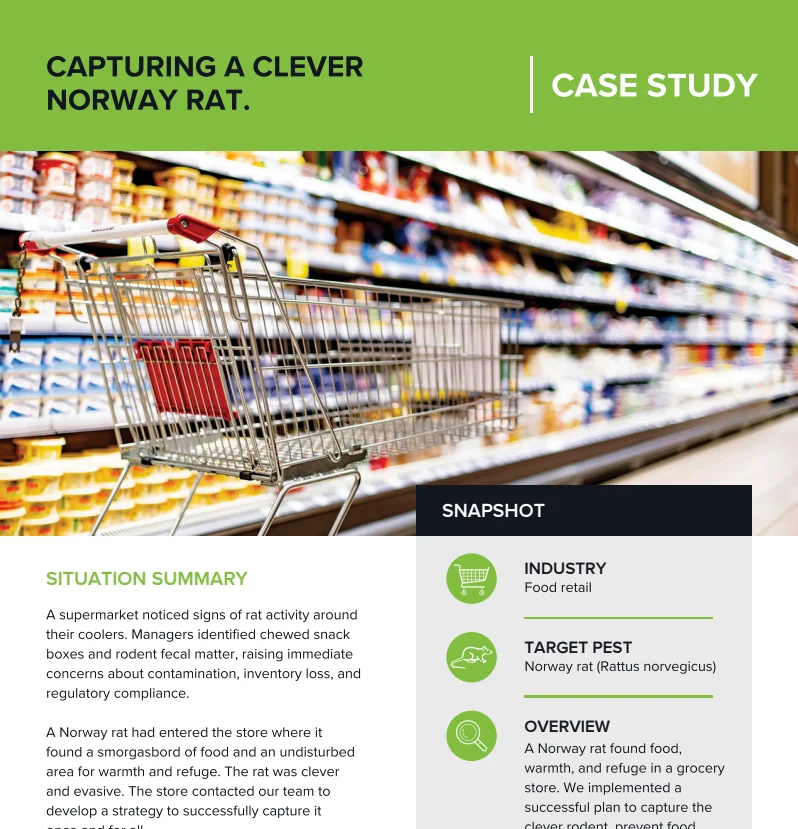
Capturing a Clever Norway Rat
Catching a sneaky Norway rat: management tactics for grocery stores.
Download Your CopySummary – Our Process Led to Long-Term Results
Our commercial pest management team determined that the Norway rat established a nesting site within the ceiling insulation above the grocery store’s cooler section. The discovery of droppings and damaged packaged foods confirmed the need for immediate corrective action.
By combining detailed inspections, adaptive trapping techniques, exclusion improvements, employee training, and coordinated community rodent management, we successfully resolved the infestation and helped the supermarket reduce future rodent risks.
If your grocery store or other food retail facility has noticed signs of rodent activity, or is dealing with another commercial pest issue, contact Bug Out for a professional inspection and customized treatment plan.
Back to Pest Control for Grocery Stores & Food Retail Businesses


